
This may sound familiar: you arrive and switch off your moped. Some time later you start it up and ride off. But as soon as your bike stands for a few days, you find the battery is dead. And it's not even a year old. As you keep riding, this happens more and more often, and you have to use the kick-starter. That's a nuisance when you're already in the saddle and ready to go. This especially affects owners of 50cc mopeds and scooters, most often Alpha and Delta mopeds.
It's in these mopeds that batteries fail fairly quickly, because their voltage regulators are built in the simplest possible way. As a result of this "economy", the regulator reduces the efficiency of the generator. In practice it looks like this: on long rides the battery gets overcharged, overheats and boils, so the electrolyte boils away and the battery loses capacity. Eventually it dies for good.
On the other hand, if you often ride with the lights on, the battery doesn't get enough charge and eventually goes completely flat. But that's not as bad as overcharging, as long as you regularly charge the battery with an external charger. Still, that's inconvenient, and you'd rather have everything just work.
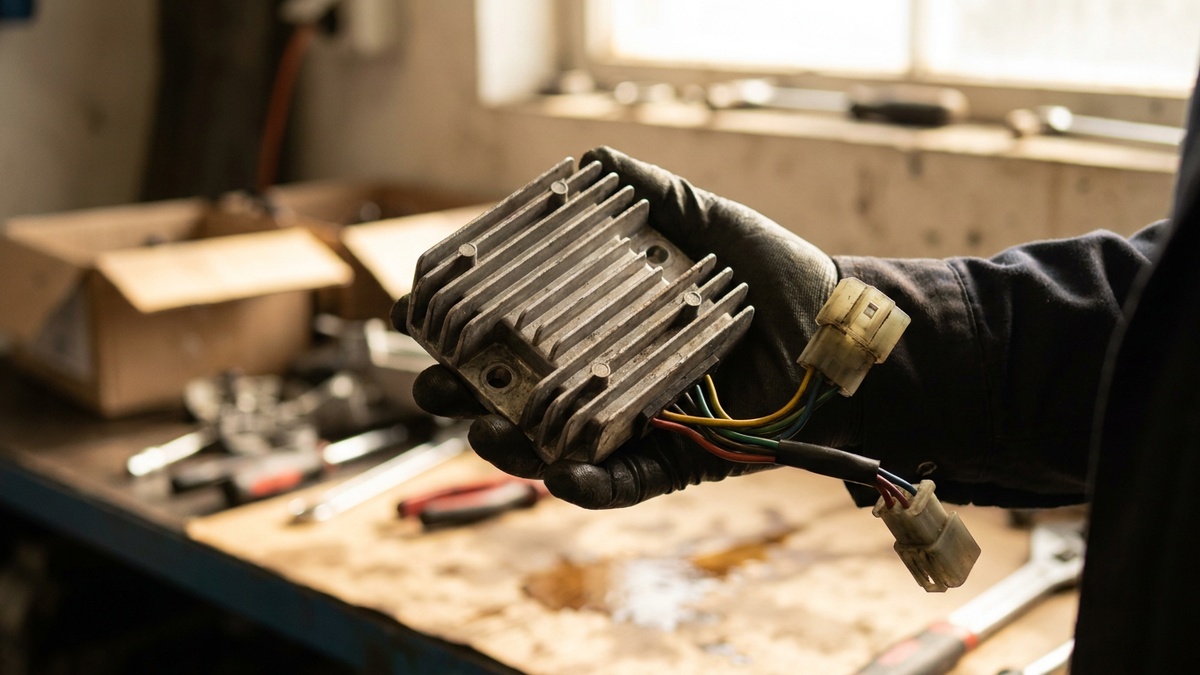
But this problem can be solved, and there are two options: build a voltage regulator yourself (luckily, there are plenty of circuits online already tested by fellow riders) or buy a ready-made regulator, for example from an Active scooter or from a 125-150cc Chinese GY-6 scooter. The second option may cost more, but it suits those who don't know their way around circuits and electronic components.
When installing a ready-made regulator, you need to rework the moped's wiring a little: the lighting is connected directly to the battery, and the ground from the generator's power coil is unsoldered and connected to one of the regulator's white or yellow wires (there are three white or yellow ones; connect the coil to any two of them, it doesn't matter which, and insulate the third), while the second connector has two wires, red for plus and green for minus, which goes to ground and the battery's negative terminal. You can add a relay switched through the ignition switch to keep the switch contacts from burning. That's all there is to it.