
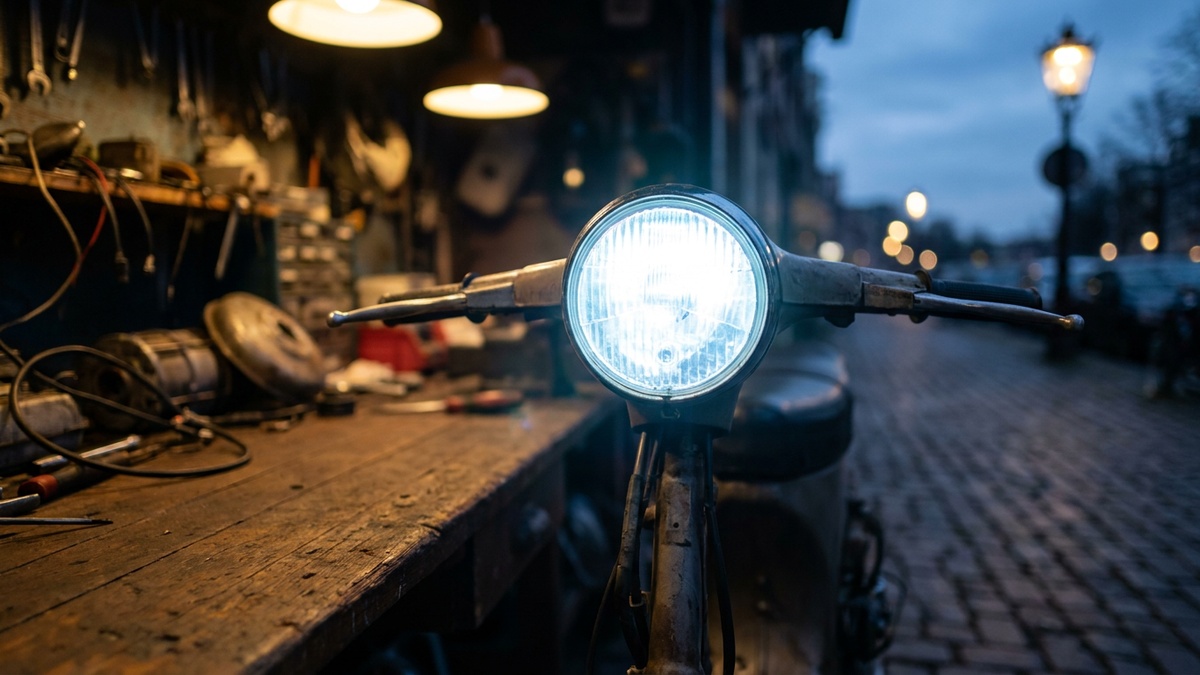
To answer this question for yourself, you need to weigh up all the pros and cons.
So, the pros. The first and most important one is the quality of the light. At the same power (35W), xenon gives more light and a brighter spot on the road. This advantage is especially noticeable on wet asphalt, in the rain. Wet asphalt absorbs a lot of halogen light, while xenon light gives better illumination (because it comes closest to sunlight at 4200/4300K, so it's best to choose bulbs with a color temperature in this range — that's where the light output is highest. There are 12000K bulbs too, but they're more about looks than practical use). This makes riding safer. And that's exactly what lights on a vehicle are for.
On top of that, xenon bulbs last longer — about 1000-3000 hours.
Now for the cons. To get good xenon light, the beam has to be focused correctly. The thing is, light from a xenon bulb spreads very differently from light from a halogen bulb. So if you just put a xenon bulb into a regular headlight, you may get the opposite effect. The headlight may not cope with such a strong light output, and there won't be a clear light spot on the road. Especially if the headlight glass is ribbed rather than smooth. Light like that will only blind oncoming drivers, which can have bad consequences. The best at focusing xenon light is a headlight with a lens and an internal shield that cuts off the beam and gives the light spot sharp edges. Then you can adjust its height so that the beam goes from the center of the headlight downward rather than in all directions. If your scooter or moped has a headlight with ribbed glass, you can replace it with smooth glass and use a bi-xenon lens as the reflector. It can work as both low beam and high beam. Or you can fit headlights designed specifically for this.
Another downside: installing xenon on a moped may mean modifying the stock wiring. You'll need to power the lights directly from the battery rather than from the stator. The thing is, the ballast draws a high peak power to start the xenon light, and only the battery can supply it. So you may also need to run heavier-gauge wires from the battery to the ballast. The stock wires are thin and long, and the light may simply not come on. But in principle, there's nothing complicated about it, and you'll get good, quality light.