
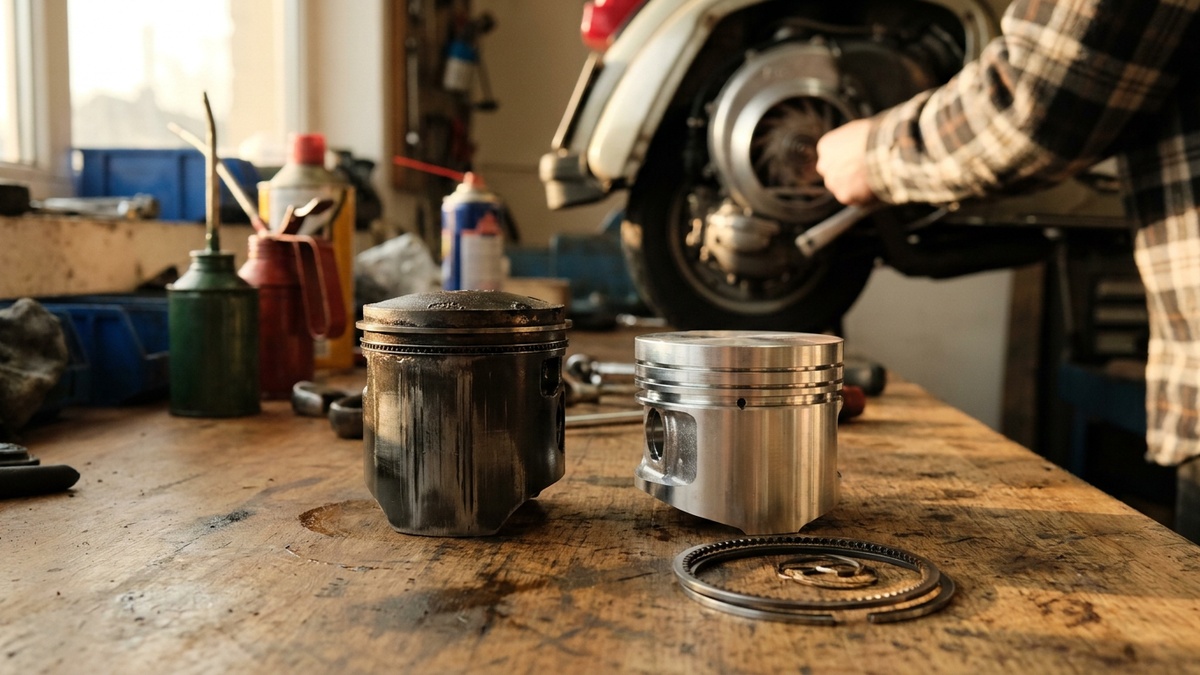
The riding season is over, and many scooter and moped owners are getting their bikes ready for winter. Some have washed and wiped off all the dirt and found a more or less warm and dry place to park. Others have followed the old saying: "prepare your sleigh in summer and your cart in winter". It's when winter sets in that many owners of motorcycles, mopeds and scooters start getting ready for the next season. Some repaint, some do tuning, and some simply repair worn assemblies and parts. Most often, that means the engine. On two-stroke scooters and mopeds, the main focus is the cylinder and piston group, because it's the parts in this section of the engine that handle gas distribution and actually take the working loads. So the wear of the piston group largely determines the engine's efficiency — that is, pulling power, top speed, fuel consumption, starting and overall performance. So if you're unhappy with any of the above, it's worth looking for signs of piston group wear. For two-stroke engines, these are:
- A noticeable loss of power
- Unstable idling
- Noise in the engine (cylinder), ringing piston rings
- Hard starting
- Increased fuel consumption
There are also indirect symptoms:
- No compression resistance when you press the kickstarter
- More smoke than usual
All these signs point to the piston kit, provided that all the other engine systems are working properly (carburetor, ignition, exhaust system).
Once you've removed the cylinder, you can tell right away, for sure, whether the piston kit has had its day. There will be brown or black carbon marks on the piston below the compression rings. This means the rings aren't sealing tightly against the cylinder walls and combustion gases were blowing past them, so the pressure on the piston is now much lower. To be completely sure, remove the piston from the connecting rod, take off the rings and insert them 15-20 mm into the top of the cylinder, squaring them up with the piston. If the gap is more than 1 mm (this value may vary from engine to engine), they should be replaced. Then take out the rings, insert the piston, raise it as if to TDC and rock the bottom of the piston left and right, up and down. If the play feels like rocking, a kind of knocking, it's better to replace everything as a set: cylinder, piston, rings.
For 4T scooters, there are slightly fewer signs of piston kit wear:
- Loss of power (as a rule, at this stage of wear you can still ride for a long time)
- Engine oil consumption (can reach 500 g/1000 km or even more)
- Blue or gray smoke from the muffler
- Hard starting when the engine is cold
Once the engine is taken apart, you can see that the rings, especially the oil control rings, are either stuck, worn down or have lost their springiness (usually as a result of overheating).
All the other signs of wear after disassembly are similar to those in two-stroke engines.
Replacing a worn piston kit is like giving your trusty iron steed a new heart.