
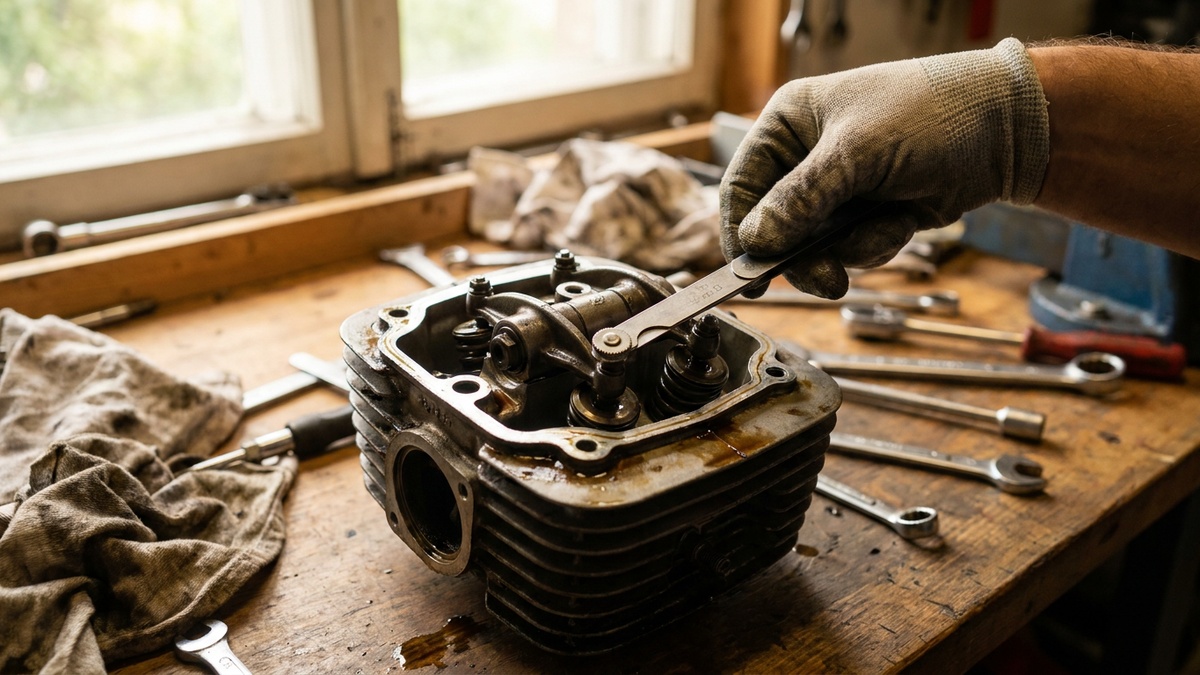
Many owners of 4-stroke scooters and mopeds read about valve adjustment in their owner's manuals. But sometimes, out of ignorance and inexperience, many riders overlook the need for this procedure. And that's a mistake. Valve clearance adjustment affects not only how the engine runs now, but also how long it will last.
You might think it's just a few fractions of a millimeter. But it turns out that both too large and too small a valve clearance hasten the death of your engine. Why? Good question. Let's start with excessive clearance. The normal valve clearance for 50–100cc mopeds is 0.05 mm for both the intake and the exhaust valve. If it gets larger, the engine starts knocking. The rattle is audible to the naked ear, and at idle the engine sounds like a sewing machine. But that's not the main thing. With this clearance, the valve timing shifts. At high revs the engine feels sluggish and has no pull.
Fuel consumption goes up. The valve train wears out. If the clearance is too small, or there's none at all, things are much worse. You lose compression, because as the engine heats up the clearance shrinks even further and the valve starts to stay slightly open. Gases blow past the partly open valve, robbing power and burning the valve seat or the valve itself. Then come the questions: why won't it go? where did the compression go? why is the spark plug black? With an outcome like that, you'll have to replace the valves, or even the whole cylinder head.
Do you really need that? It's easier to adjust the valves every 1000 km and have no worries. For this you will need (at least for the Delta and Alpha) a 17 mm wrench, a set of feeler gauges, a 9 mm wrench, and a 3.5 mm wrench or pliers. The adjustment is done on a cold engine (in summer, or on a slightly warmed-up engine in sub-zero temperatures). Unscrew the spark plug. Set the piston to top dead center (TDC) at the end of the compression stroke so that the valves are free. To check, you can unscrew the plug on the left crankcase cover and watch the mark.
The "T" mark should be in the middle of the inspection window. Using the 17 mm wrench, unscrew the cap to access the adjusting screw on the rocker arm (be careful not to break it, as it's usually plastic), and measure the clearance with a feeler gauge. The 0.04 gauge should slide in freely, the 0.06 won't go in, and the 0.05 should go in with slight resistance but not get stuck. If that's the case, screw the cover back on. If not, loosen the locknut on the adjusting screw (literally half a turn), and using your fingers, pliers or the 3.5 mm wrench, set the gap between the lower end of the screw and the end of the valve to 0.05 mm, tighten the locknut and take a check measurement. If everything is right, screw the cap back on and repeat the same procedure on the second valve.
Don't forget to tighten the caps, otherwise oil will leak out. That's all. Start the engine and warm it up. You'll hear how quietly it can actually run. Riding is much more pleasant that way.