
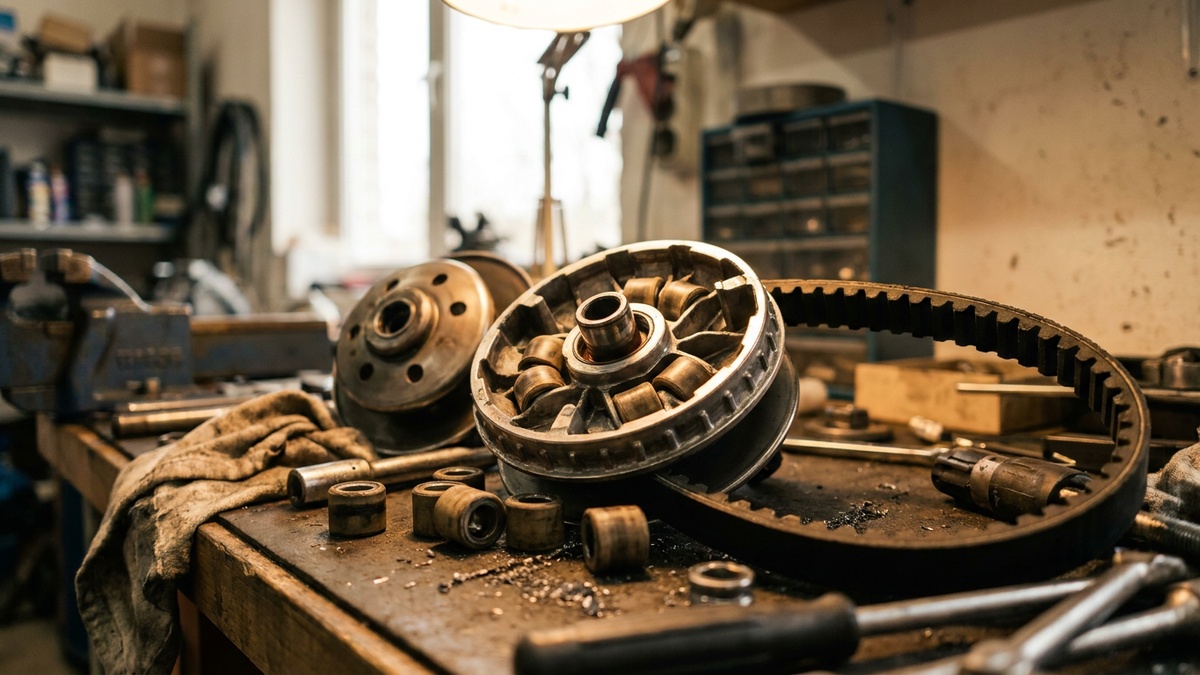
First, it helps to understand what a variator actually is. A variator is a mechanical transmission that can smoothly change its gear ratio within a certain range. There are several types of variators: friction variators and positive-engagement variators.
Friction variators, in turn, come in the following types: face, cone, ball, multi-disc, toroidal, wave and V-belt. Positive-engagement variators include the chain variator and the high-torque variator. Practically all kinds of scooters use a V-belt variator.
This variator consists of a drive pulley, a driven pulley and a V-belt. How it works depends on engine speed. It gets its name from the trapezoidal shape of the belt. The gear ratio depends on how fast the variator spins and changes as the belt moves along the pulley.
This lets the scooter move off without jerks and pick up speed smoothly and quickly. The drive belt must not slip on the pulleys: heavy slipping can lead to rapid wear of the parts. If your scooter revs high when pulling away but doesn't move, that's a sign the variator has failed.
Keep in mind that a variator needs preventive maintenance, especially if you want it to last longer. It should be taken apart, cleaned of dirt, and any rust removed and painted over. If you're going to buy a variator for your scooter, pay attention to the manufacturer.
It's best to choose a brand that has proven itself and is known for quality and reliability. Remember: quality parts and proper care are the key to a long and trouble-free life for your scooter. If you're looking to buy scooter parts, get in touch with us.