
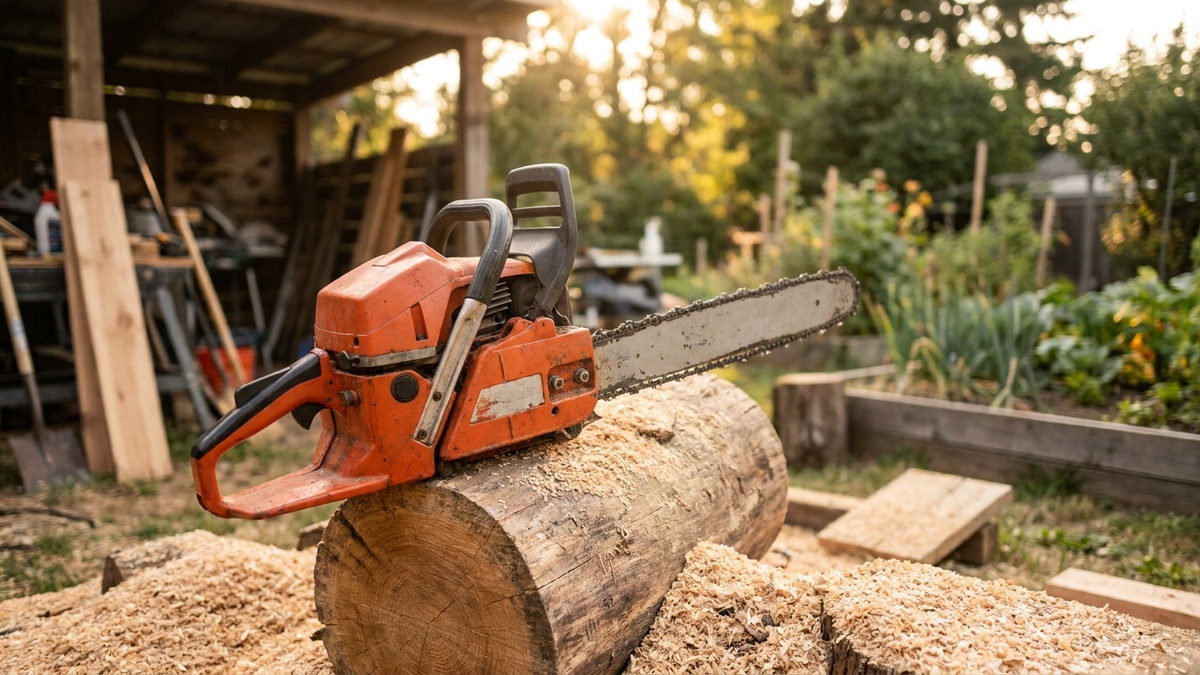
If we want to buy a chainsaw, we face yet another question. Which chainsaw should you choose? What should you look for? It's worth noting right away that saws fall into two groups: electric saws and gas-powered chainsaws. This article is about gas chainsaws, since electric saws are aimed at a very narrow group of users and we won't be discussing them.
Electric saws have both a major advantage and a significant drawback. The advantage is the noise level, or rather the near absence of noise, as well as the ability to work indoors. The drawback, of course, is the long cord and always being tied to a power outlet. So, gas chainsaws. All chainsaws can be roughly divided into three groups:
- Household
- Semi-professional
- Professional
To choose the right saw from these categories, let's talk a little about each of them. Household chainsaws have the fewest features, which is why they're cheaper than all the others. As the name suggests, these chainsaws are made for basic needs around a country plot. So, on average, these saws shouldn't be run for more than 20 hours a month. The main advantage of household chainsaws is their low power and light weight.
Some of them can be used with one hand. Most often you won't find an inertia chain brake on this kind of saw, only a contact one, although even that does its job perfectly well for such needs. Household chainsaws are the most common today, and you can buy them at an affordable price. Semi-professional chainsaws are a cut above household ones. First, they're more powerful and heavier, and you can fit a longer guide bar. They have a well-developed anti-vibration system that reduces the vibration reaching the operator's hands and body. A saw like this is already closer to a professional one, only with a much shorter service life.
They're used in construction, for limbing at logging sites, by landscaping services and so on. Professional chainsaws are best suited for daily, long hours of use — say, in logging. They can run non-stop for up to 10 hours a day. Their service life can reach 1500 engine hours. They have lots of features, and their anti-vibration system is more carefully designed. The engine power allows a larger-pitch chain, which increases cutting performance and speed while reducing operator fatigue. These chainsaws don't come cheap.
Before deciding which saw to buy, it's a good idea to think about what jobs it will need to do and how often it will be used. Another important point is the manufacturer. It's better to choose a saw you'll be able to find parts for and replace them yourself. Experience shows that branded or "trendy" saws, if they break down and end up at a service center, can sit there for several weeks — say, because of some little rubber ring or gasket that has to be ordered, with a long wait. In short, the choice is yours.